Ideas about Pests in your garden!
Recently, I have taken a real interest in bugs in the garden. Not just the bugs, but what they do.
We just finished out our Spring Semester Edible Landscaping class, which had a large focus on pollination, pests, weeds, and all that good stuff. I'd like to share some of the notes I have on the topic and perhaps give an update on the status of the Phoenix Garden very soon!
I have also scanned the notes from this particular lecture we received on "Biological Balance with Insects" to share with you all if you're interested. I'd like to thank our professor Lisa McAndrews for her excellent and inspiring teaching this semester!
Some words of wisdom:
- No garden, not even a well-tended one, is immune to pests & disease
- Diversity is the key to a healthy landscape (if same plants together, easy for pests that like it to spread to neighbor plant)
- Without "pests", the predatory and parasitic insects would not be able to reproduce (and thus eat your "pests"
- The primary way to deter garden pests is by keeping healthy plants in a thriving, diverse garden environment. (healthy soil, choosing the right varieties for your local climate, rotating vegetables & keeping plants evenly watered & fed)
- Healthy plant attract fewer pests

Some info on pesticide use:
- Synthetic chemicals to control pests have been routing in the last 40-50 years.
- Despite the use of pesticides, no pests have been "eradicated"
- Pesticides cause the death of valuable beneficial bugs (more sensitive and breed less) that will in turn keep other insect populations in check
- Forced to adapt to chemical attacks, insects mutate and survive - developing resistance to pesticides and needing more intense dosage
- Particularly harmful to bees that are unable to breakdown pesticides - they are extremely sensitive since they are intended to pick up small particles
Alternative to Pesticides: Integrated Pest Management
- Based on management of pests rather than eradication - choosing appropriate plants and giving them good growing conditions
- Physical controls such as traps and barriers
- Pheromone traps - to track population patterns
- Biological controls - releasing natural enemies & disease-causing micros that attack pests (the predator & prey approach)
- Diversity of plants - so pests can't find favorite plants so easy
- Few insects and mites, sow bugs, earwigs, snails & slugs are "pests"
- Most insects are either neutral or beneficial to your purposes
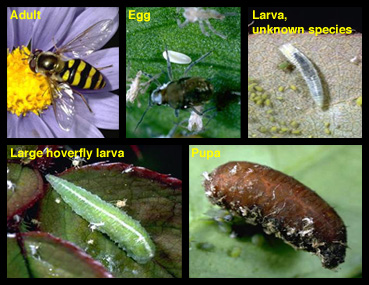
 Notes on the "Good Guy Bugs" (or Beneficials)
- Beneficials will do most pest control for you (Lacewings, Hoverfly larva,
and Ladybugs eat aphids) - problem is recognizing them and their larval stages - 2 Main groups of good bugs: predators eat "bad bugs" - ladybugs, lacewing
- Parasitoids lay eggs in the bodies of bad bugs who eat their way out - wasps, syrphid (hover) fly
- Patience is the key to pest control
- The population of "bad bugs" has to build up to a significant level before the predators will come to handle the problem
- Won't kill all the pests because need to leave food for next generation
- Some pests don't have natural predators here - brown snail and japanese beetle. If use pesticides make sure are natural and only effect them or upset balance of other insects in the garden
 Attracting Beneficials
- Most beneficials need high-proten, high sugar foods and have short mouthparts that can't reach into a flower for nectar & pollen.
- Two major plant families that fit their needs: Sunflower (Asteraceae) and Parsley (Apiaceae) families
- Sunflower family examples: yarrows, artemisias, feverfew, marigolds, zinnias, aster calendulas,gazanias, artichokes & lettuce
- Parsley family examples: carrots, celery, celeriac, dill, coriander, parsley, & fennel
 For more details on these notes, please see our DreemGarden informational page for resources!
Labels: DreemEducation, DreemGardens
posted by D.r.e.e.m. Reality @ 3:54 PM


0 Comments:
Post a Comment
Subscribe to Post Comments [Atom]
<< Home